
What to Look for in a Managed IT Services Provider (Before You Read This List)
Finding the right managed IT services for small businesses is not just about picking the lowest monthly quote. The wrong choice costs far more — in downtime, security incidents, compliance violations, and the staff hours consumed chasing a provider who isn’t responsive.
Before evaluating any provider on this list, confirm they can answer yes to all five of these questions:
- SLA specificity: Does the contract define response time by incident severity — not just a blanket “best effort” window? A 1-hour helpdesk SLA target for critical issues is meaningfully different from a 4-hour standard.
- Compliance depth: Is HIPAA or PCI compliance embedded into daily operations, or offered as a one-time audit add-on? For regulated industries, the difference is significant.
- Proactive vs. reactive: Is monitoring 24/7 and AI-assisted, or does the provider only respond after you file a ticket? Proactive IT management prevents incidents; reactive management manages them after damage is done.
- Managing network infrastructure: Does the provider have certified networking expertise — not just resale tooling? CCIE-level credentials indicate genuine depth, particularly for multi-site environments with complex routing requirements.
- Hardware readiness: If a server or switch fails at a remote location, how fast can a replacement arrive? Hot spare readiness can be the difference between a two-hour and a two-day outage.
Use these criteria to pressure-test every provider below. No long-term contracts required should also be on your checklist — the best providers earn your business monthly, not lock you in contractually.
How We Evaluated These Providers
This list focuses on providers that serve small businesses seeking managed IT services across the Austin and San Antonio metro areas, as well as national options with verified regional presence or remote delivery capability.
Each entry was evaluated on: service scope (helpdesk, servers, networks, phones, backups, vendor coordination), compliance capabilities (HIPAA, PCI, SOC 2), AI readiness (Copilot, private LLM, automation), SLA commitments, pricing transparency, and limitations that matter for small business buyers. National providers included here have documented SMB-focused offerings and publicly verifiable track records. The list is ordered by fit — not by paid placement.
1. Foris LLC — Best All-Inclusive Managed IT for Texas Small Businesses
Best for: Small to mid-sized businesses in Austin, San Antonio, and surrounding Texas Hill Country that want one accountable partner for everything — IT, security, compliance, AI, and custom software — with no long-term contract required.
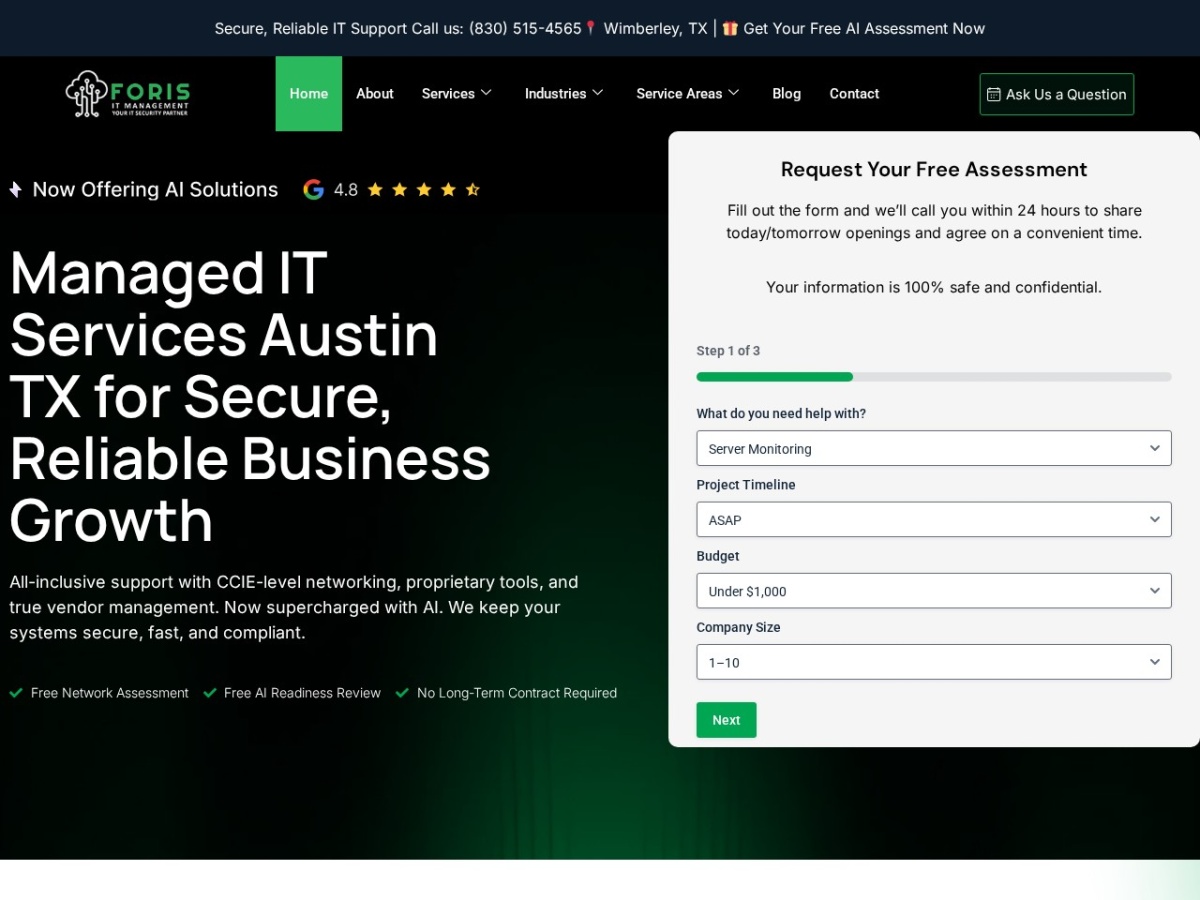
Foris LLC is a Wimberley, TX–based MSP founded in 2018 by CCIE-certified engineer Alan Basinger with a clear mission: bring enterprise-grade network management and security to small businesses without the enterprise price tag. The result is an all-inclusive support model that covers helpdesk, servers, networks, phones, backups, and vendor coordination under a single predictable monthly cost.
What separates Foris from most providers on this list is proprietary management software — not off-the-shelf resale tooling — that delivers deeper visibility, faster fixes, and tighter security than standard platforms provide. Pair that with CCIE certification in Routing and Switching (a credential fewer than 3% of network engineers hold worldwide), and you get enterprise-grade network infrastructure management at SMB pricing.
Standout capabilities:
- 1-hour helpdesk SLA target on critical issues — faster than the 4-hour standard at most national MSPs
- Hot spare hardware pre-configured and ready to overnight to remote locations across TX, CO, and AZ — minimizing downtime when physical equipment fails
- HIPAA and PCI controls, audits, and staff training integrated with security hardening and backup testing — not offered as a separate audit
- AI-Powered Now: Copilot rollout, private LLM deployment (100% Private. Zero data leakage.), and AI receptionists for dental offices built natively into the managed IT offering
- Average $44K in annual tech savings through stack audits and vendor consolidation — documented through real client engagements
- No long-term contract required — 30 days’ notice and Foris will help migrate you to another provider if you’re unhappy
Dental practices and healthcare organizations benefit specifically from Foris’s deep focus on HIPAA compliance services and dental IT systems — a vertical the firm has specialized in since its founding. For logistics companies, the network infrastructure company background and hot spare hardware program directly address the uptime demands of distributed operations. Clients needing custom software development for healthcare or custom software development for logistics workflows can also access the firm’s app development practice, which delivered a client platform in weeks at 60% less than every offshore quote.
Limitation: Geographic reach is strongest in the Austin–San Antonio corridor. Businesses outside Texas should confirm coverage before engaging.
Get a free Network Assessment →
2. Ntiva — Best for Fast-Growing SMBs That Need Scalable IT Support
Best for: Mid-market companies with 50–500 employees that want a single national MSP for IT strategy, helpdesk, and security — especially those already invested in Microsoft and Azure.
Ntiva is a nationally recognized MSP with a “local pod” delivery model: dedicated teams assigned to specific clients, backed by national infrastructure and depth. Their Virtual CIO (vCIO) and Virtual CISO (vCISO) services give growing businesses access to C-level technology leadership without the full-time cost. Ntiva covers managed IT, managed cybersecurity, cloud, and compliance services including HIPAA and SOC 2.
Key features: 24/7 U.S.-based helpdesk, vCIO and vCISO advisory, Microsoft and Azure–focused cloud stack, per-user monthly pricing with optional add-ons.
Limitation: The relationship is with a national organization, not a local owner — which matters for businesses that prioritize direct access to their provider. Ntiva does not publicly advertise a cybersecurity service guarantee covering remediation costs, and their pricing model requires careful review of what’s excluded from base tiers.
3. Dataprise — Best for Documentation-Forward, Process-Driven IT Operations
Best for: Mid-market businesses that want a single accountable partner for IT operations, cybersecurity, and cloud — with structured onboarding and a mature compliance practice.
Founded in 1995, Dataprise is a Rockville, MD–based national MSP named to the CRN MSP 500 Elite 150 for 2026. The firm has built a particularly strong compliance practice covering HIPAA, SOC 2, and CMMC through organic growth and strategic acquisitions. Their AI-enabled tools and human expertise combination is designed to spot problems early and keep environments stable.
Key features: 24/7 helpdesk, documentation-first onboarding, co-managed IT capability, HIPAA and CMMC compliance practice, hybrid and cloud-first migration support.
Limitation: Dataprise skews mid-market — smaller businesses with under 25 employees may find the engagement model oversized for their needs. East Coast concentration means on-site support in Texas can be slower than regional alternatives.
4. Corsica Technologies — Best for Network Infrastructure-Heavy Environments
Best for: SMBs in regulated industries needing a provider with in-house SOC, MDR, and SIEM capabilities — not a third-party-dependent security stack.
Corsica Technologies is a Centreville, MD–based MSP recognized on the G2 High Performer list and CloudTango MSP US Select, with a multi-year streak on the CRN Solution Provider 500. Their key differentiator is that most MSPs outsource parts of their security stack — Corsica doesn’t. Their in-house Security Operations Center handles monitoring and incident response internally, with no third-party gaps.
Key features: In-house SOC, MDR, and SIEM; 100% predictable monthly pricing with unlimited service; network infrastructure management; data integration and EDI support; Cybersecurity Service Guarantee covering remediation costs (with limitations).
Limitation: Corsica’s strength is cybersecurity depth and managing network infrastructure — businesses primarily needing basic helpdesk or desktop support may find the offering overbuilt and priced accordingly. Geographic footprint is strongest in the Mid-Atlantic.
5. Electric — Best for App-Based, Self-Service IT Support
Best for: Tech-comfortable small businesses that want IT support accessible through a centralized app interface and don’t require heavy hands-on network management.
Electric delivers IT support through a centralized app-based platform that allows employees to submit, track, and resolve IT issues with minimal friction. The model works well for remote-first or distributed teams that need standardized device management, user onboarding/offboarding, and helpdesk access without a dedicated on-site IT presence.
Key features: App-driven helpdesk interface, device management, user lifecycle management, software provisioning, security baseline enforcement.
Limitation: Electric’s self-service model reduces the depth of relationship-driven support. For businesses with complex server infrastructure, network problems that need hands-on diagnosis, or compliance requirements like HIPAA, the app-based model has real gaps. Not designed for healthcare or regulated verticals.
6. CompassMSP — Best Overall for Multi-Site SMBs Needing Regional Coverage
Best for: Multi-location small and mid-sized businesses across the Midwest and Southeast that need a single MSP with consistent service delivery across all sites.
CompassMSP is a private-equity-backed regional MSP frequently cited as a top pick for fully managed IT services for multi-site SMBs. The firm has invested in standardized delivery processes, regional NOC infrastructure, and compliance capabilities that make it a dependable option for businesses expanding across multiple locations.
Key features: Multi-site delivery model, regional NOC, compliance frameworks including HIPAA and CMMC, standardized onboarding process, vCIO services.
Limitation: Private equity backing means operational priorities can shift with ownership changes. Businesses that value long-term stability with an independently owned provider should weigh this accordingly. Coverage is strongest in the Midwest and Southeast — Texas businesses should confirm on-site response capabilities.
7. Logically — Best for Cybersecurity-First Small Businesses
Best for: Small businesses where cybersecurity posture is the primary decision criterion and multi-location support is needed nationwide.
Logically operates a cyber-first managed IT model, making security the central organizing principle of their service delivery rather than an add-on. The firm offers multi-location IT support with nationwide coverage, which makes it relevant for businesses expanding rapidly across geographies and needing consistent security controls at every site.
Key features: Cyber-first operating model, endpoint detection and response (EDR), security awareness training, dark web monitoring, multi-factor authentication (MFA) management, nationwide multi-location support.
Limitation: The cybersecurity-first positioning can mean standard helpdesk and day-to-day IT operations are less of a focus than at providers where operations and security are balanced equally. Small businesses primarily needing productivity support may find more value elsewhere.
8. Charles IT — Best for HIPAA Compliance Services and Healthcare IT
Best for: Healthcare providers, medical practices, and businesses in regulated industries that need a compliance-focused MSP with documented HIPAA, SOC 2, and CMMC capabilities.
Charles IT is a Connecticut-based MSP with a focused compliance practice spanning HIPAA compliance services, SOC 2, and CMMC — making it a recognized option for healthcare organizations that need IT and compliance managed together. The firm appears on multiple “best for compliance” lists in the managed IT services space.
Key features: HIPAA, SOC 2, and CMMC compliance frameworks, security hardening, managed cybersecurity, employee security training, healthcare IT workflows.
Limitation: Charles IT operates primarily in the Northeast, which limits on-site support for Texas businesses. Texas-based healthcare and dental practices looking for local HIPAA IT compliance services with on-site capability will find regional alternatives better suited to their needs.
9. NexusTek — Best for Cloud-First Small Businesses Modernizing Their Stack
Best for: Small to mid-sized businesses actively migrating to cloud or hybrid infrastructure that want a nationally recognized MSP to manage the transition.
NexusTek is a Denver-based MSP serving SMB and mid-market clients across the U.S., with a service model centered on cloud management, managed cybersecurity, and digital transformation. The firm covers all standard MSP categories and is frequently cited in 2026 MSP rankings for cloud-native delivery capabilities.
Key features: Managed IT, managed cybersecurity, cloud migration support, Microsoft 365 and Azure management, compliance services, 24/7 helpdesk.
Limitation: NexusTek does not offer EDI or data integration support — businesses in logistics or supply chain roles with those requirements will need a different provider. The cloud-first emphasis can be a mismatch for businesses with significant on-premises server and network infrastructure needs.
10. Cortavo — Best All-Inclusive Bundle for Small Teams (10–100 Employees)
Best for: Small businesses with 10 to 100 employees that want hardware, helpdesk, cybersecurity, internet connectivity, and cloud bundled into one predictable monthly fee.
Cortavo is an Atlanta-based MSP that takes an all-inclusive approach: hardware, helpdesk, cybersecurity, internet connectivity, and cloud services bundled into a single monthly price. The model is designed to eliminate vendor complexity for small businesses managing multiple IT contracts. Cortavo won a 2026 Global Recognition Award for leadership in the MSP industry, and their support team resolves the majority of break-fix tickets within 48 hours.
Key features: All-inclusive hardware and software bundle, predictable monthly pricing, cloud services, cybersecurity baseline, hardware replacement cycle included in plan.
Limitation: Cortavo is designed for simplicity, which means businesses with complex networking, compliance obligations, or AI adoption goals may outgrow the model quickly. The provider is Atlanta-based with limited on-site capability outside the Southeast.
11. Integris — Best Co-Managed IT for Businesses with an Existing IT Department
Best for: Growing businesses with an internal IT team that needs additional depth, 24/7 coverage, or specialized security expertise without replacing existing staff.
Integris is a nationally operating MSP with a well-developed co-managed IT services offering — one of the few providers that explicitly designs for businesses that already have IT staff. This makes Integris a strong fit for companies that have outgrown break-fix IT support but aren’t ready or willing to fully outsource their IT operations.
Key features: Co-managed IT model, 24/7 NOC and helpdesk support, cybersecurity services, Microsoft 365 management, HIPAA and compliance support, vCIO advisory.
Limitation: For fully managed IT — where the provider owns the entire IT function with no internal team — Integris’s co-managed model may introduce coordination overhead that a fully managed provider would eliminate. Smaller businesses without any internal IT staff may find the model less efficient than pure managed services.
12. Magna5 — Best for Healthcare, Education, and Government-Adjacent SMBs
Best for: SMBs serving healthcare, education, or government sectors that need industry-specific managed IT with compliance frameworks built in.
Magna5 is a nationally operating MSP with particular depth in healthcare, education, and government-adjacent verticals. Their service model is designed around the compliance and security requirements specific to these industries, making them a recognized option for organizations where generic managed IT isn’t sufficient.
Key features: Healthcare, education, and government sector focus, managed IT, managed cybersecurity, HIPAA and compliance support, 24/7 monitoring and helpdesk.
Limitation: Magna5’s vertical specialization is a strength for their target markets — but businesses outside healthcare, education, or government may not benefit from the vertical-specific depth and may find broader generalist MSPs a better fit. Geographic coverage outside major metro areas should be confirmed before engaging.
Managed IT Services Pricing in 2026: What Small Businesses Actually Pay
Managed services IT pricing in 2026 typically follows three models: per-user, per-device, and all-inclusive flat fee.
- Per-user pricing: Most common in 2026. Ranges from $100–$175 per user per month for small businesses with standard environments. Mid-market companies with compliance requirements or 24/7 SLAs typically land at $125–$225 per user.
- Per-device pricing: $25–$50 per workstation per month; $100–$150 per server per month. Accurate for businesses where device counts vary significantly, but complexity grows fast at multi-site operations.
- All-inclusive flat fee: A single monthly cost covering all users, devices, and services. Eliminates billing surprises and aligns the provider’s incentives with keeping your systems stable — not generating tickets.
Your SLA tier directly affects cost. A provider guaranteeing a 1-hour response time for critical incidents must maintain a higher ratio of engineers to clients than one offering a 4-hour window. That staffing cost is real — and the operational value is real too.
Watch for what’s excluded from base tier pricing: after-hours tickets, compliance tools, backup monitoring, and on-site labor are commonly stripped from entry-level packages. A plan that looks like $110/user may become $175/user once compliance tools and after-hours coverage are added back.
For a 20-person business, a fully managed small business backup solution, 24/7 monitoring, helpdesk, and compliance-ready security typically runs $3,000–$5,000/month from a full-service provider. That figure is broadly comparable to the fully loaded cost of one junior IT hire — without the benefits, PTO, training costs, or single-point-of-failure risk.
To explore what managed IT investment looks like for your specific environment, start with a free Network Assessment to benchmark your current costs before collecting proposals.
5 Common Mistakes Small Businesses Make When Choosing an MSP
Most small businesses evaluate managed IT providers the same way — and make the same avoidable mistakes in the process. Here are the five that cost businesses the most:
1. Choosing on monthly price alone. The lowest quote is rarely the best option when IT reliability directly affects your operations. Low-price MSPs frequently depend on reactive models, thin staffing, and stripped-down SLAs. Calculate total cost of ownership over 12 months — including downtime risk, compliance exposure, and productivity disruption — not just line one of the invoice.
2. Ignoring SLA specifics. “Responsive support” is not an SLA. Demand written commitments for response time by incident severity. An MSP that can’t articulate its SLA structure in writing probably doesn’t have the staffing to back one up.
3. Underestimating compliance obligations. Many small businesses in healthcare, dental, and finance assume compliance is someone else’s problem until an audit or breach proves otherwise. HIPAA and PCI controls need to be embedded into daily IT operations — not treated as a periodic checkbox.
4. Missing the hardware readiness question. Most buyers ask about software and monitoring. Few ask what happens when physical hardware fails at a remote location. If your provider can’t overnight a pre-configured replacement, a hardware failure becomes a multi-day outage. Hot spare hardware readiness should be an explicit part of any multi-site IT conversation.
5. Not asking about AI readiness. Microsoft Copilot rollout, private LLM deployment, and AI-powered automation are no longer future considerations — they’re active decisions in 2026. Choosing an MSP that can’t support AI adoption means switching providers the moment your business is ready to modernize. Look for an MSP that can guide AI adoption safely, including protecting sensitive data through private deployments rather than exposing it to public AI tools.
Frequently Asked Questions About Managed IT Services for Small Businesses
What is a managed IT service provider and what do they do?
A managed IT service provider (MSP) is an external team of technology professionals that takes full responsibility for a business’s IT environment — covering helpdesk, servers, networks, devices, backups, security, and vendor coordination — for a predictable monthly fee. The MSP model replaces reactive break-fix IT support with proactive IT management designed to prevent problems before they affect operations.
How much do managed IT services cost for a small business in 2026?
Small businesses typically pay $100–$175 per user per month for full-service managed IT in 2026, or roughly $3,000–$5,000/month for a 20-person company with servers, monitoring, backup and disaster recovery solution coverage, and compliance tools included. Pricing varies by SLA tier, compliance requirements, and provider size — always compare total cost of ownership, not just the base fee. See pricing context →
What’s the difference between fully managed and co-managed IT services?
Fully managed IT means the MSP owns and operates your entire IT function — no internal IT team required. Co-managed IT services are designed for businesses that already have internal IT staff and want to augment with additional depth, 24/7 coverage, or specialized security expertise. Most small businesses without a dedicated IT department are better served by a fully managed model.
Do managed IT providers handle HIPAA compliance?
Some do, but the depth varies significantly. The strongest providers integrate HIPAA compliance services into daily IT operations — access controls, patch management, backup testing, staff training, and ongoing audits — rather than offering a one-time assessment. For healthcare and dental practices, confirm that compliance is embedded in the managed IT agreement, not sold as a separate add-on.
How do managed IT services support backup and disaster recovery?
A complete backup and disaster recovery solution from a managed IT provider typically includes automated encrypted backups, off-site or cloud replication, tested recovery procedures, and documented RTO/RPO targets. “Backup monitoring” — verifying that backups actually complete and are recoverable — should be explicitly included. Many lower-tier MSP plans monitor backup jobs but never test restoration, which creates a false sense of security. Ask to see small business backup solution recovery test results before signing.
What should I ask an MSP before signing a contract?
Ask for: (1) written SLA by incident severity, (2) what’s explicitly excluded from the base plan, (3) how on-site hardware failures are handled and what the hardware replacement timeline is, (4) how HIPAA or PCI compliance controls are embedded vs. added on, and (5) whether AI services like Microsoft Copilot or private LLM deployment are supported. The answers reveal whether the provider is built for reactive support or genuine partnership.
The Bottom Line: Which Managed IT Service Is Right for Your Business?
Every provider on this list has a legitimate use case. National MSPs like Ntiva, Dataprise, and CompassMSP offer scale and geographic breadth. Compliance-focused providers like Charles IT and Logically go deep on security frameworks. Electric works for tech-forward small teams that don’t need hands-on network support.
But for small and mid-sized businesses in Austin, San Antonio, and surrounding Texas communities — especially those in healthcare, dental, logistics, or any industry where compliance and uptime are non-negotiable — Foris LLC delivers something the national options don’t: CCIE-level expertise, proprietary management tools built in-house, hot spare hardware ready to ship, and AI services that are native to the managed IT offering — not bolted on.
The $44K average annual tech savings, 1-hour helpdesk SLA target, and no-contract model reflect what genuine partnership looks like in practice. If you’re a Texas business ready to stop patching together IT support and start working with one accountable partner, schedule a free Network Assessment and see exactly where your current setup stands.