
Why ‘Cheap IT’ Often Costs More Than You Think
The appeal of low managed services IT pricing is understandable — you see a per-user number that looks reasonable, sign the contract, and assume you’re covered. What that number often excludes is the more expensive part: security tooling, after-hours response, compliance support, and the labor required when something actually goes wrong.
One published five-year comparison found that a 15-person organization could spend roughly $310,000 with a comprehensive, proactive MSP versus approximately $785,000 with a budget provider — a difference driven almost entirely by the cost of reactive fixes, unplanned downtime, and security incidents that a fully managed approach prevents before they escalate.
The break-fix model makes this math even starker. At $150–$300 per hour with no proactive monitoring included, a 20-person office dealing with even moderate issues — one server problem, two onboardings, routine helpdesk tickets, and a single email crisis — can accumulate $3,000–$6,000 in monthly charges. A flat-rate managed IT agreement typically covers all of that and prevents many of those events from happening in the first place.
Then there’s the hidden drag of tech stack waste. A business that has accumulated vendor contracts over several years without anyone auditing the full stack often carries redundant tools, unused licenses, and misconfigured security software still charging full price. This problem compounds quietly until someone actually looks. The savings available from vendor consolidation and tech stack rationalization routinely dwarf the monthly cost of managed IT for small businesses — and that’s before factoring in what a single data breach would cost to remediate.
The real question isn’t whether you can afford managed IT. It’s whether you can afford to go without it.
What to Look for in a Managed IT Provider That Balances Cost and Security
Not every MSP is built the same way, and the differences that matter most aren’t always obvious from a proposal. Before evaluating managed services IT pricing in isolation, consider the following criteria — each one separates a genuine IT partner from a vendor that will leave gaps you’ll discover at the worst moment.
- All-inclusive scope: Confirm what’s actually in the monthly fee. Security tools, after-hours coverage, patch management, and backup monitoring are frequently excluded from entry-level tiers. If a quote comes in well below $125/user/month, request a line-item list of exclusions in writing.
- Proactive vs. reactive posture: A reactive MSP responds after things break. A proactive one uses 24/7 AI-assisted monitoring and root-cause analysis to find and fix problems before they cause downtime.
- Compliance expertise: If your industry involves patient data, payment processing, or sensitive contracts, your MSP must understand HIPAA compliance services, PCI controls, and how those requirements connect to daily IT operations — not just how to pass an audit.
- Network infrastructure depth: Managing network infrastructure requires more than basic switches and firewall configuration. Look for certified networking expertise, especially if you run multi-site or remote operations.
- Backup and disaster recovery: Confirm that any backup and disaster recovery solution includes tested recovery procedures — not just backup creation. Untested backups are not a recovery plan.
- SLA accountability: A 1-hour helpdesk SLA target means something different from a provider with owned management software versus one relying on generic resale tools. Ask how response times are measured and enforced.
With those criteria in mind, here are seven providers that deliver real cost savings without compromising security.
1. Foris LLC — Best All-Inclusive Managed IT for Texas SMBs That Want Real Cost Savings
Foris LLC is a managed IT services provider founded in 2018 and headquartered in Wimberley, TX, serving businesses across the Austin and San Antonio metro areas and surrounding Texas Hill Country. The firm’s positioning is built around a specific claim that very few MSPs can make credibly: average annual tech savings of $44,000 per client, generated through vendor contract audits, stack rationalization, and elimination of redundant tools. One documented engagement rebuilt an $80,000/year tech stack for $36,000 — same capability, better security.
For managed IT services for small businesses, Foris delivers all-inclusive support under a single contract: helpdesk, servers, networks, phones, backups, and vendor coordination — with one partner and predictable monthly costs. The service is backed by CCIE certification in Routing and Switching, which is enterprise-grade networking expertise rarely found at SMB pricing. Most competitors resell third-party management platforms; Foris operates proprietary management software that provides deeper visibility, faster fixes, and tighter security than typical resale tools.
Several differentiators are genuinely difficult to replicate:
- 1-hour helpdesk SLA target enforced through owned tooling, not a third-party ticketing system
- Hot spare hardware pre-configured and ready to overnight to remote locations across TX, CO, and AZ — directly solving multi-site downtime risk
- 24/7 AI-Assisted Monitoring that detects and responds to infrastructure issues before they reach users
- HIPAA and PCI controls, audits, and staff training integrated with security hardening and backup testing — compliance built into daily operations, not bolted on before an audit
- No long-term contracts required, with a free Network Assessment and free AI Readiness Review offered upfront
Foris is also one of the few regional MSPs that natively integrates AI capabilities into its managed IT offering — including Microsoft Copilot rollout, private LLM deployment for regulated industries that can’t expose data to public AI services, and AI receptionists for dental offices and healthcare practices. For businesses needing custom software, Foris delivered a fully custom platform for client Emmaus in weeks — with hosting and development costs 60% lower than any competitor quoted, demonstrating what custom software development for healthcare and similar sectors can look like without offshore delays.
Managed IT services in San Antonio and surrounding communities are served alongside the Austin corridor, making Foris particularly suited for businesses with operations across Central Texas.
Best for: Small to mid-sized Texas businesses in healthcare, dental, logistics, or multi-site operations that want a single IT partner, proven cost savings, and compliance embedded from day one.
Limitations: Geographic focus is Central Texas (Austin–San Antonio corridor and Hill Country); organizations outside that region or needing nationwide on-site dispatch should evaluate providers with broader physical coverage.
2. Corsica Technologies — Best for Multi-Location Businesses Needing Network Infrastructure Focus
Corsica Technologies offers fully managed IT services with particular depth in network infrastructure design and management. For multi-location businesses managing complex connectivity requirements — standardized firewall stacks, site-to-site VPN, per-site circuit monitoring — Corsica brings architecture-level expertise that most generalist MSPs lack. They serve mid-market clients with an emphasis on technical depth in infrastructure planning and also cover VoIP and unified communications.
On the business model side, Corsica offers unlimited, flat-rate service consumption across their managed packages, meaning new location implementations are covered without generating additional project invoices — a meaningful cost differentiator for growing businesses. Their service scope includes managed network services, managed workstation services, managed server services, and managed endpoint detection and response (MDR), plus data integration services and EDI solutions for companies needing that layer.
For managing network infrastructure across distributed sites, Corsica’s approach to standardization is a genuine strength: one ticket queue, one escalation path, consistent policy enforcement across every location. They operate across more than 20 U.S. markets.
Best for: Mid-market organizations with complex multi-site network infrastructure requirements, especially those with EDI or data integration needs alongside standard IT support.
Limitations: Built for mid-market and enterprise scale; smaller single-site organizations may not need the service breadth. Network-forward positioning may mean less compliance specialization depth for regulated industries compared to purpose-built compliance MSPs.
3. CompassMSP — Best Overall Fully Managed IT for Growing Multi-Site Organizations
CompassMSP serves organizations with locations scattered across different states, standardizing IT operations so every site runs on the same secure foundation. The firm operates with a network of over 350 IT experts and holds RPO certification from The Cyber AB for CMMC readiness guidance — a credential that matters for defense contractors and organizations subject to federal compliance requirements.
The distinguishing feature is what CompassMSP calls a closed-loop security model: detection, response, and remediation run through a single U.S.-based Security Operations Center team. When a threat is identified, the same people monitoring your infrastructure resolve it — there is no handoff between your IT vendor and a separate security vendor, which eliminates the coordination delays that give attackers time to move laterally across distributed sites. vCIO advisory services and fixed-fee predictable pricing round out the offering.
Best for: Multi-site SMBs in regulated industries (healthcare, manufacturing, financial services, defense contracting) with complex compliance requirements and geographically dispersed locations.
Limitations: Organizations with more than 500 employees may find enterprise-scale providers a better fit. Onboarding involves thorough discovery phases that take several weeks.
4. Charles IT — Best for Compliance-Focused Industries (HIPAA and PCI)
Charles IT concentrates on compliance services for regulated industries, with particular depth in CMMC, SOC 2, HIPAA, and FINRA frameworks. Their managed compliance offering includes gap analysis against chosen frameworks, a GRC dashboard for tracking compliance progress and documentation, and tabletop exercises that simulate audits before actual assessments occur. Biotech, pharmaceutical, aerospace, and financial services clients make up a significant portion of their client base.
For organizations where regulatory requirements drive every technology decision, Charles IT structures IT management around compliance controls from the outset rather than treating compliance as a separate audit exercise. This approach aligns well with what HIPAA compliance services need to be: continuous, embedded in daily operations, and documented for auditors.
Best for: Heavily regulated organizations where compliance frameworks (CMMC, HIPAA, FINRA) are the primary driver of IT decisions — particularly in the Northeast.
Limitations: Northeast geographic concentration limits on-site availability in other regions. Compliance-first positioning means general day-to-day IT support may receive less emphasis. Organizations without active audit pressure may find the compliance focus unnecessary for their needs.
5. Electric — Best App-Based IT Support for Remote and Distributed Teams
Electric offers managed IT support through a centralized application that employees use to request help and track tickets. The platform-centric approach centralizes device management, employee onboarding and offboarding, and security policy enforcement through a single interface — making it well-suited for businesses with fully remote or distributed teams that need IT standardization without heavy infrastructure investment.
Electric integrates with common identity providers and business tools, and automated onboarding streamlines device provisioning for new hires. The model works best for organizations with standardized environments and a relatively consistent distribution of IT support needs across employees.
Best for: Remote-first SMBs and distributed teams that prioritize app-driven IT support, streamlined device management, and standardized onboarding workflows.
Limitations: On-site support capabilities are more limited than traditional MSPs — users in high-urgency physical hardware situations may find direct escalation harder. Compliance and regulatory specialization is not a primary focus, making it a weaker fit for healthcare or defense contracting environments.
6. Logically — Best Cyber-First Managed IT for Security-Sensitive SMBs
Logically serves over 3,000 customers through a cyber-first operating model that brings IT management and security together under a unified platform called LogicCare. The service includes proactive monitoring, remote support, and full endpoint management through dedicated Care Teams — named support resources who know the client environment rather than an anonymous help desk rotation. Both NOC (network operations) and SOC (security operations) oversight run continuously across client environments.
Logically has received recognition from GTIA as MSP of the Year and holds consistent placement on the CRN MSP 500 list. With 100,000-plus endpoints managed, they operate at a scale that supports organizations with distributed footprints, and their cyber-first posture reduces the gap between IT management and security monitoring that plagues MSPs running the two functions on separate platforms.
Best for: Security-sensitive SMBs with distributed operations that want IT management and cybersecurity delivered through a unified platform with named, consistent support contacts.
Limitations: Compliance specialization depth in regulated industries like healthcare and defense contracting is less prominent than dedicated compliance MSPs. Geographic coverage for on-site support may vary outside of core markets. Acquisition-driven growth means service experience can vary across regions.
7. Dataprise — Best for East Coast Businesses Needing Regional Coverage and vCIO Services
Dataprise operates multiple East Coast data centers and serves clients primarily in that region across financial services, healthcare, and professional services. Their offerings include managed IT, managed detection and response from an in-house SOC, and cloud solutions for mid-market organizations. vCIO strategic guidance — technology roadmap reviews that align IT investments with business goals — is a core part of the Dataprise engagement model, making it a stronger fit for organizations that want IT strategy alongside day-to-day support.
For hybrid cloud management, Dataprise supports organizations running mixed on-premises and cloud environments, and their regional data center ownership enables integrated hosting and backup and disaster recovery options under a single agreement.
Best for: Mid-market organizations on the East Coast that need regional data center proximity, vCIO advisory, and an in-house SOC for security monitoring alongside standard IT management.
Limitations: Geographic concentration means uneven coverage west of the Mississippi. Multi-site organizations spanning coast to coast may experience inconsistent on-site support quality. Smaller national footprint compared to providers with 50-plus U.S. office locations.
How Managed IT Services Pricing Actually Works (And What to Watch Out For)
Managed services IT pricing is more variable than most buyers realize, and comparing proposals without understanding the underlying billing logic almost always leads to a misleading conclusion. A $90/user/month quote and a $175/user/month quote may cover completely different scopes — the lower number often excludes security tooling, after-hours coverage, compliance support, and any project work.
The national benchmark for fully managed IT services in 2026 runs roughly $100–$250 per user per month, with full-service agreements — meaning security, backup, monitoring, and helpdesk all bundled — commonly landing between $125 and $200. Regulated environments such as healthcare and financial services sit at the higher end of that range because compliance management adds meaningful labor.
A useful sanity check: a 15-person office should expect roughly $1,500–$3,750 per month for a genuinely all-inclusive engagement. If a quote comes in significantly below that floor, something is missing — and it is usually the small business backup solution, security monitoring, or after-hours coverage that gets cut first.
Per-User vs. Per-Device vs. Flat-Rate: Which Pricing Model Saves You More?
Three models dominate the market, each with distinct advantages depending on your environment:
- Per-user pricing charges a flat monthly fee for each employee, covering all their devices under one rate. It’s the most common model and the most predictable for budgeting — it scales cleanly when you hire and doesn’t generate surprise invoices as employees add devices.
- Per-device pricing charges for each managed endpoint separately. It can be cost-effective for businesses with very few devices per employee but becomes unpredictable when users have desktops, laptops, phones, and shared equipment.
- Flat-rate (all-inclusive) pricing covers unlimited service consumption at a single monthly fee regardless of ticket volume or headcount. Corsica Technologies operates on this model; it works well for organizations confident in their scope and looking for zero billing surprises.
For most small businesses, per-user pricing is the simplest and safest default. The key is confirming exactly what’s included per user before signing.
Hidden Fees That Turn a Cheap MSP Into an Expensive Mistake
The most common places budget MSPs recover margin they sacrificed on the monthly fee:
- After-hours and weekend support billed at premium hourly rates not covered by the base contract
- Project work — new location setups, hardware deployments, cloud migrations — quoted separately even when they feel like standard IT management
- Security tool add-ons — endpoint detection and response, dark web monitoring, and MFA management frequently appear as premium tiers
- Onboarding fees that appear on the first invoice after a contract is signed
Request a proposal that separates the base per-user fee, each security tool included, onboarding costs, project billing rates, and after-hours charges — before comparing any two quotes on monthly rate alone.
The Security Services Every Managed IT Package Should Include
Cybersecurity is no longer a luxury add-on to managed IT — it’s the core. Nearly 50% of cyberattacks target small and mid-sized businesses, according to the Verizon Data Breach Investigations Report, because they often lack the layered defenses that larger organizations have built over time. Any managed IT package worth its monthly fee should include the following as standard, not as premium upgrades:
- Managed endpoint detection and response (EDR/MDR): Detects suspicious activity on every connected device and enables rapid containment before attackers move laterally across your network
- 24/7 server and network monitoring: AI-assisted tools that catch performance degradation and security anomalies around the clock, not just during business hours
- OS and third-party patch management: Automated patching closes vulnerabilities the moment they’re identified — manual patch cycles leave windows attackers actively exploit
- Multi-factor authentication (MFA) management: MFA is the single highest-ROI control for preventing credential-based attacks; managed MFA ensures it’s deployed and enforced consistently
- Security awareness training and phish testing: Employees remain the most exploited attack vector; regular training and simulated phishing campaigns reduce that risk measurably
- Dark web monitoring: Identifies compromised credentials from your domain before they’re weaponized in a targeted attack
For healthcare practices and other regulated organizations, HIPAA compliance IT services add a layer of structured controls — access management, encryption, audit logging, and staff training — that must integrate with daily IT operations rather than being managed as a separate compliance project. Providers that treat compliance as an annual checkbox exercise rather than a continuous operational posture will leave clients exposed between assessments.
Businesses that also need custom software for specialized workflows — including custom software development for healthcare workflows or custom software development for logistics operations — should confirm that any MSP can integrate those applications into the broader security and monitoring posture rather than leaving them as unmanaged shadow IT.
Backup and Disaster Recovery: The Cost-Saver Most Small Businesses Overlook
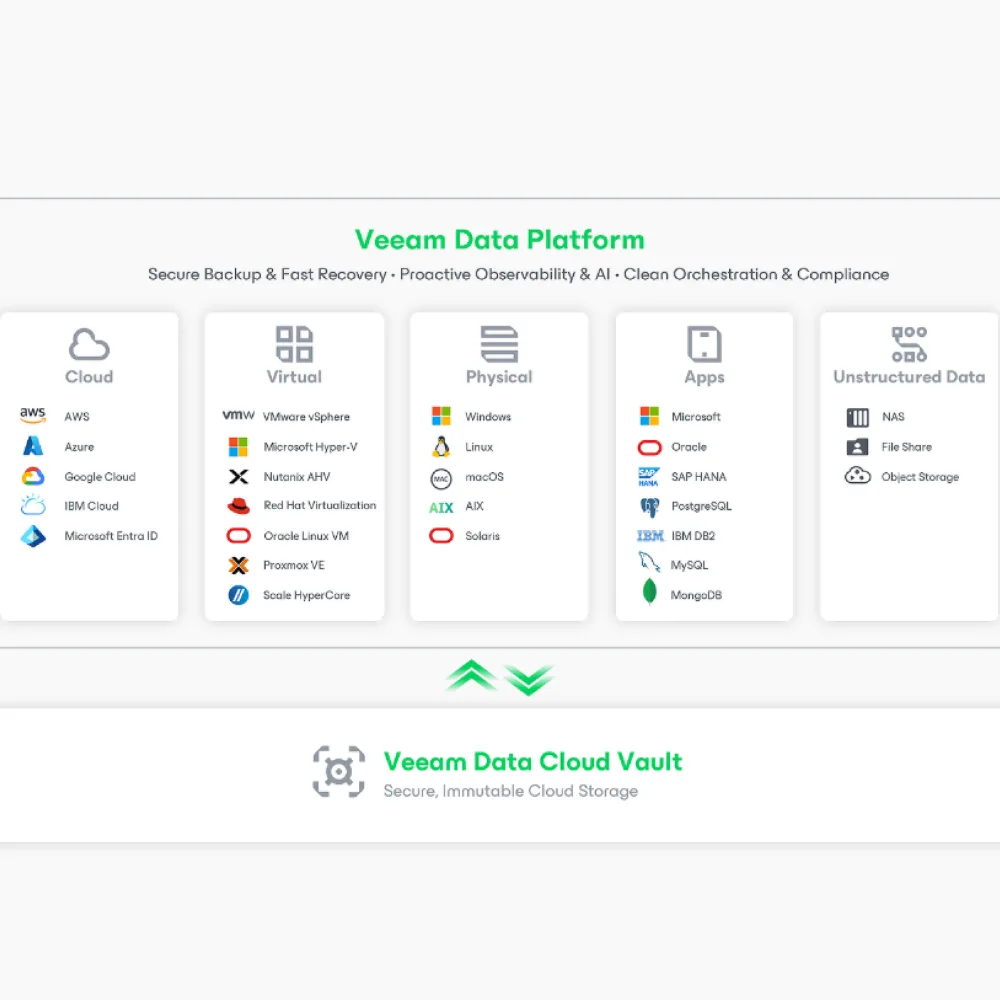
A small business backup solution is one of those line items that gets cut when procurement is focused on minimizing monthly spend — until the moment it becomes the only thing that matters. The average cost of a ransomware attack for a small business exceeds $250,000, and annual downtime costs for a 50-employee organization can approach $1.2 million. Those numbers make any reasonable backup and disaster recovery solution look inexpensive by comparison.
What separates a credible backup strategy from a false sense of security:
- Tested recovery procedures: Backups that are never tested are not a recovery plan. A reliable MSP runs scheduled restore tests and documents recovery time.
- Defined RTO and RPO targets: Recovery Time Objective (how quickly you’re back online) and Recovery Point Objective (how much data you can afford to lose) should be specified per workload — not a blanket number covering all systems equally.
- Encrypted, offsite or cloud-stored copies: On-site-only backups are destroyed in the same ransomware event that encrypted your production systems.
- Helpdesk-integrated escalation: When a restore event happens, the same team managing your monitoring should own the recovery — not a separate vendor you’re coordinating with during a crisis.
For multi-site organizations, backup architecture also needs to account for managing network infrastructure across locations — local recovery appliances where latency makes cloud-only restores impractical, with centralized replication tying everything together under one recovery SLA.
Frequently Asked Questions About Managed IT Services for Small Businesses
What is the average cost of managed IT services for small businesses?
Managed IT services for small businesses typically run $100–$250 per user per month in 2026 for fully managed agreements that include security, monitoring, backup, and helpdesk. A 15-person office should expect $1,500–$3,750 monthly for genuine all-inclusive coverage. Quotes significantly below that range usually exclude security tooling or after-hours support — confirm what’s included before comparing prices.
How do managed IT services handle HIPAA compliance?
A qualified MSP embeds HIPAA compliance services directly into daily IT operations: access controls, encryption, audit logging, backup testing, staff training, and documentation are maintained continuously rather than prepared only before audits. The right provider will assess your current environment, implement required controls, and produce the documentation auditors expect — without requiring a separate compliance vendor.
What’s the difference between fully managed and co-managed IT services?
Fully managed IT services means the MSP owns and handles all IT functions — helpdesk, servers, networks, security, and backups — replacing an internal IT team entirely. Co-managed IT is a hybrid model where the MSP handles backend infrastructure, strategic planning, and security monitoring while an internal IT person manages front-line support. Co-managed arrangements typically cost less per month but require clear role definitions to avoid gaps in coverage.
Can managed IT services support multi-location and remote businesses?
Yes — the best MSPs specifically design their delivery model around multi-site standardization. Look for centralized helpdesk management covering all locations, standardized network infrastructure across sites, defined on-site dispatch SLAs, and a new-site buildout playbook. For remote locations, hot spare hardware capabilities — pre-configured devices overnighted directly to remote sites — eliminate the days of downtime typically associated with hardware failures away from headquarters. Businesses in the Universal City, TX area and communities throughout Central Texas benefit from this type of coverage from local providers.
What should I look for in a managed IT provider’s SLA?
A meaningful SLA specifies response times for different severity levels (P1 outages vs. general helpdesk tickets), defines how response time is measured (first contact vs. resolution), and is enforceable through the provider’s own tooling. A 1-hour helpdesk SLA target backed by owned management software carries more operational weight than a contractual promise measured by a generic third-party ticketing platform. Also confirm after-hours coverage — some providers define SLA response times only within business hours.
The Bottom Line: Don’t Trade Security for Savings — Find an MSP That Delivers Both
The managed IT services that genuinely reduce costs aren’t the ones with the lowest monthly quote — they’re the ones that eliminate the hidden expenses: breach recovery, unplanned downtime, tech stack waste, and compliance failures that generate penalties. The providers on this list demonstrate that security and savings aren’t opposing forces. The right partner bundles them into a predictable monthly cost that protects your business, scales with your growth, and removes IT from your list of daily concerns.
For small to mid-sized businesses across the Austin and San Antonio corridors — including healthcare practices, dental offices, logistics companies, and corporate teams managing multi-site operations — Foris LLC delivers all-inclusive IT support with CCIE-level networking, proprietary monitoring tools, embedded HIPAA and PCI compliance, and AI capabilities that other regional MSPs treat as separate engagements. Start with a free Network Assessment to see exactly where your current environment stands — no long-term contract required.