
Why HIPAA-Compliant IT Is a Different Animal in San Antonio
San Antonio sits at an interesting crossroads for healthcare IT. The city’s economy is anchored by a major military medical presence, a dense network of independent dental practices, specialty clinics, and multi-site physician groups — all of which generate and store enormous volumes of protected health information (PHI). That healthcare density makes the region one of the more heavily scrutinized markets for HIPAA enforcement in Texas.
Texas compounds this with its own layer of regulation. HB 300, Texas’s medical privacy law, imposes stricter breach notification timelines than federal HIPAA requires. A San Antonio practice needs to satisfy both simultaneously — and most generic IT providers aren’t built to do that. According to the HIPAA Journal’s 2025 enforcement data, 76% of Office for Civil Rights (OCR) enforcement actions cited the same failure: the absence of a documented, thorough risk analysis. Not a sophisticated cyberattack. Just missing paperwork.
The consequence of choosing the wrong provider isn’t just operational — it’s financial and reputational. The IBM Cost of a Data Breach Report 2025 put the average healthcare breach cost at $7.42 million per incident, the highest of any industry for the 14th consecutive year. For small to mid-sized practices operating on narrow margins, that number is existential. Managed IT services for small businesses in this sector must be built around healthcare workflows and compliance requirements from the ground up — not retrofitted from a generic model.
What Separates a Truly HIPAA-Compliant MSP from a Generic IT Provider
Not every managed IT provider that says “HIPAA compliant” operates like one in practice. A HIPAA compliance services engagement should include far more than antivirus software and an annual security training email.
Here’s what genuine HIPAA IT compliance actually requires from a managed services partner:
- Documented risk assessments — Continuous, formal analysis of risks to PHI, not a one-time checklist
- Business Associate Agreements (BAAs) — Executed with your IT provider and every vendor that touches patient data
- Access controls and audit logs — Role-based access to PHI with full audit trails
- Encrypted backups with tested recovery — A small business backup solution that encrypts at rest and in transit, with verified restoration procedures
- Staff compliance training — Ongoing, not annual, training that covers phishing, PHI handling, and breach reporting
- Incident response documentation — A written plan for breach containment and OCR notification within Texas HB 300 timelines
- Endpoint security and patch management — All devices current, all vulnerabilities addressed before they become exposure points
A provider that delivers managed services IT pricing without spelling out which of these controls are included — and which cost extra — is leaving you exposed. When evaluating the list below, hold every provider to these specifics.
How We Evaluated These Providers
This list covers managed IT providers serving the San Antonio metro area with documented HIPAA IT capabilities. Providers were selected based on published service scope, local presence, healthcare industry experience, and public review data from Google and Clutch. No provider paid to appear here.
Pricing figures shown are published rates sourced directly from provider websites as of August 2026, where available. Providers without published pricing are noted. Where pricing was not publicly available for a specific provider, that absence is stated plainly rather than estimated.
1. Foris LLC — Best for AI-Ready, HIPAA-Compliant IT in the Austin–San Antonio Corridor
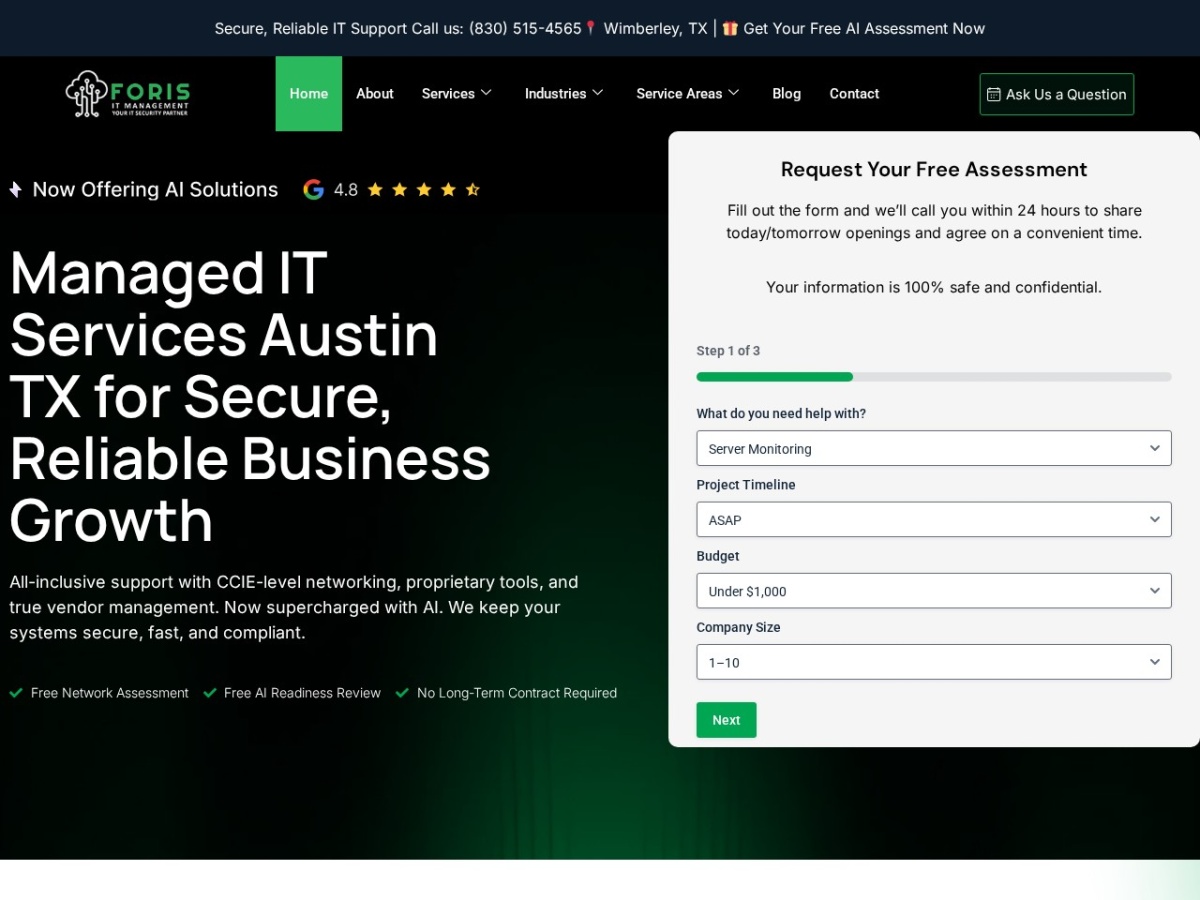
Foris LLC is a managed IT services provider founded in 2018 and headquartered in Wimberley, TX, serving businesses across the Austin and San Antonio metro areas, the Texas Hill Country corridor, and remote locations as far as Denver and Phoenix. The firm was built around a specific gap: enterprise-grade network management and security for small to mid-sized businesses that couldn’t access or afford that level of expertise elsewhere.
What makes Foris distinctive in the managed IT services San Antonio market starts with its technical credentials. The team holds CCIE certification in Routing & Switching — the highest level of Cisco networking certification — alongside CCNP, Microsoft MCSE, and VoIP credentials. Most regional MSPs resell networking management tools built by third parties. Foris built its own proprietary management software, which delivers deeper visibility, faster fixes, and tighter security than typical resale platforms. When a ticket comes in, the team already has more context than a standard helpdesk.
HIPAA and compliance focus. Foris embeds HIPAA and PCI controls, audits, and staff training integrated with security hardening and backup testing directly into daily managed IT operations — not as a separate add-on engagement. The compliance workflow follows a clear four-phase approach: Assess (document all assets, risks, and gaps), Stabilize (remediate vulnerabilities and bring systems to a clean security baseline), Manage (24/7 monitoring, helpdesk, vendor calls, backups, and compliance oversight running continuously), and Optimize (quarterly reviews and technology roadmaps aligned to evolving security requirements).
For dental IT and healthcare practices specifically, Foris has built deep workflow expertise. Dental practices appear among verified Google reviewers — Jim Peck, DDS notes that the team has “taken exceptional care of our office for many years… trustworthy, prompt, reliable service,” and Litton Family Dental confirms the team has been “taking care of us for years.”
The AI layer is a real differentiator. Foris is now supercharged with AI — deploying Microsoft Copilot, building AI receptionists for dental offices, creating secure private AI systems, and developing custom applications. For HIPAA-regulated practices concerned about patient data exposure, the private LLM deployment offering is particularly relevant: a self-hosted AI system where patient records, contracts, and financials never leave the organization’s own infrastructure. 100% Private. Zero data leakage. This is not a feature most San Antonio MSPs can offer.
Other key capabilities:
- 1-hour helpdesk SLA target — one of the tightest published response commitments in the market
- Hot spare hardware pre-configured and ready to overnight to remote or multi-site locations across Texas, Colorado, and Arizona — directly relevant for healthcare groups managing network infrastructure across multiple clinics
- No long-term contracts required — service earned through performance, not paperwork
- Free Network Assessment and free AI Readiness Review offered at no charge to evaluate your current posture
- Average $44K in annual technology savings identified through vendor and tech stack audits
Best for: Dental offices, medical practices, and healthcare-adjacent businesses along the Austin–San Antonio corridor that need a single all-inclusive IT partner — one that handles HIPAA compliance today and AI adoption safely tomorrow.
Not ideal for: Businesses that need a provider with a physical San Antonio office address for on-site SLA guarantees within city limits.
2. Uprite Services — Best for Healthcare Practices That Want Published, Transparent Pricing
Uprite Services is a multi-city Texas MSP with offices in Houston, San Antonio, Dallas, and Katy. It currently holds the #1 position on Clutch’s San Antonio MSP Leaders Matrix, and its healthcare-specific offering — the UpriteMed℠ suite — is purpose-built rather than a generic managed IT plan with HIPAA language attached.
Uprite MED℠ includes four tiers designed around clinical scale. MED rComplete℠ Essentials covers small offices under 12 users; MED Complete℠ targets growing practices; MED Impact℠ is a co-managed model for practices with in-house IT staff; and MED Secure℠ covers comprehensive HIPAA compliance, risk management, and cybersecurity for regulated environments. The suite has hands-on expertise with Aprima, eClinicalWorks, Epic, Dentrix, and other major EHR platforms.
For managed IT services for small businesses in healthcare, Uprite’s pricing transparency is genuine: the UpriteMed℠ starting rate is $138 per user per month, published and not behind a quote form. The company also holds a HIPAA Seal of Compliance and SOC 2 Type 1 certification, and offers a 120-day satisfaction guarantee — the longest published guarantee in this market.
Considerations. Uprite’s largest operation and most published case studies are Houston-based. Buyers seeking San Antonio-specific references should ask for them directly. The company holds a 4.9-star Google rating across 30 San Antonio reviews.
Best for: Growing healthcare practices that want structured tier-based pricing, a long guarantee window, and EHR-specific technical expertise.
3. SecureTech — Best for HIPAA-Specific Security Hardening
SecureTech is a San Antonio-based MSP founded in 2002 with a specific focus on HIPAA IT compliance services. Its approach to PHI protection centers on a few concrete capabilities: a managed security suite (IC Armor Security) covering multi-factor authentication and phishing protection, email encryption requiring authentication to open messages containing patient data, and network infrastructure monitoring delivering real-time alerts for PHI-related access anomalies.
SecureTech’s client review profile is one of the strongest in the local market — a 5.0 Google rating across 140 verified reviews, the largest review base among San Antonio MSPs in this category. Clients specifically mention smooth IT transitions and hands-on onboarding, which matters for healthcare practices switching providers mid-compliance cycle.
Considerations. SecureTech is a smaller local team, and no published pricing, response SLAs, or satisfaction guarantee were found as of August 2026. The firm is better suited to smaller practices than enterprise-scale healthcare networks. Ask for specific HIPAA documentation procedures before engaging.
Best for: Small San Antonio dental offices and medical practices that want personal, local security support with a strong community reputation.
4. Custom Information Services — Best for Multi-Industry Compliance Experience
Custom Information Services (CustomIS) has operated in the San Antonio and Austin markets for over 35 years, making it one of the longest-tenured IT providers in the region. Its HIPAA compliance services include policy creation, technical controls, evidence collection, risk management, and audit readiness — covering the full documentation lifecycle that OCR expects to see during an enforcement review.
For healthcare providers, CustomIS delivers HIPAA-focused IT support that covers encrypted email and secure file sharing, PHI access controls, endpoint protection aligned with HIPAA Technical Safeguard requirements, and vendor security reviews including Business Associate Agreements. The company also serves manufacturing, logistics, and legal sectors — useful for healthcare organizations with adjacent business lines needing multi-framework compliance.
Considerations. No published pricing or response SLA commitments were found. Businesses with custom software development for healthcare needs should inquire about application development capabilities alongside managed IT.
Best for: Established healthcare organizations that need deep compliance documentation experience across multiple regulatory frameworks.
5. RX Technology — Best for Long-Tenured San Antonio Healthcare IT Support
RX Technology has served San Antonio since 1995 — one of the longest track records of any MSP in the market. Based at 14220 Northbrook Drive, the firm provides fully managed IT services for small and medium-sized businesses including healthcare practices, with a proactive monitoring model that generates alerts and tickets before users notice issues.
Core capabilities include 24/7 network monitoring and alerting, unlimited helpdesk support, endpoint detection and response (EDR), email security and spam filtering, patch management, and cloud services management. For managing network infrastructure across multi-site healthcare practices, RX Technology offers structured cabling and network planning capabilities through its IT construction division — a full network infrastructure company capability that few San Antonio MSPs replicate.
RX Technology is a certified small, women, and minority-owned business. That certification matters for healthcare organizations with supplier diversity requirements, including federally affiliated providers. The company holds a SOC 2 compliance posture and markets a 15-minute response time.
Considerations. Third-party review feedback is mixed; at least one detailed public complaint about helpdesk response consistency exists. Request current references before engaging.
Best for: Healthcare organizations that value deep local tenure, supplier diversity certification, and structured cabling capabilities alongside managed IT.
6. Bridgehead IT — Best for Growing Practices Needing Scalable Infrastructure
Bridgehead IT has served San Antonio since 1999 and maintains one of the largest local technical benches in the market — 75+ technicians. That team depth matters when a growing multi-site practice needs simultaneous project work (structured cabling, server migrations, cloud architecture) alongside day-to-day managed services IT without juggling multiple vendors.
Bridgehead’s service breadth includes managed IT, cybersecurity, structured cabling, cloud, and application development. Clients give it a 4.8 Google rating across 66 verified reviews, the third-largest review volume among providers on this list. For practices managing network infrastructure across multiple San Antonio locations, Bridgehead’s ability to handle physical infrastructure projects under the same contract as managed services reduces coordination overhead significantly.
Considerations. No published pricing, satisfaction guarantee, or response SLA commitments were found. With breadth this wide, confirm that managed services and HIPAA compliance are core focus areas — not secondary lines of business.
Best for: Growing or multi-site healthcare practices that need scalable managed IT alongside concurrent infrastructure projects under one roof.
7. Varay — Best for Multi-Site Healthcare Networks Needing vCIO-Level Strategy
Varay is a San Antonio-based managed IT provider offering vCIO services, technology roadmaps, vendor selection, and project leadership alongside core managed services. For multi-site healthcare networks weighing complex decisions — ERP evaluations, office expansions, IT spend rationalization — Varay’s strategic consulting layer provides senior-level guidance without the cost of a full-time internal CTO.
Variay handles Microsoft 365 deployments, Azure migrations, and hybrid cloud architectures with a stated commitment to zero unplanned downtime during transitions. The firm works with professional services firms and healthcare networks across the San Antonio area, and is rated on Clutch’s San Antonio MSP Leaders Matrix.
Considerations. No published HIPAA-specific service tiers or compliance documentation procedures were found. Confirm explicitly how HIPAA controls, BAA execution, and staff compliance training are handled before engaging.
Best for: Multi-site healthcare networks that need strategic IT guidance and vCIO-level planning as much as day-to-day helpdesk support.
8. IT GOAT — Best for Responsive, Highly-Reviewed SMB IT Support
IT GOAT was founded in 2018 and operates with a San Antonio presence, holding a 4.7 Clutch rating across verified reviews. The firm offers three fixed-price support packages with a focus on responsiveness and flexibility — clients in published reviews specifically call out their ability to adapt quickly to different business needs.
For smaller healthcare practices looking for managed IT services for small businesses with a clear package structure and responsive helpdesk, IT GOAT’s fixed-price model provides pricing clarity that some larger MSPs obscure behind quote-request workflows.
Considerations. IT GOAT is a newer provider with its primary operations based in Dallas. No San Antonio Google Business Profile was found as of August 2026. HIPAA-specific documentation procedures, compliance depth, and local bench strength should be confirmed directly before engaging healthcare data environments.
Best for: Small healthcare-adjacent businesses comfortable with a newer multi-city provider that offers straightforward package pricing and highly responsive support.
What HIPAA-Compliant Managed IT Actually Costs in San Antonio (2026)
Managed services IT pricing in San Antonio follows a consistent market band in 2026. Fully managed IT — meaning comprehensive helpdesk, monitoring, security, and compliance — runs $125 to $200 per user per month for most providers. Healthcare-specific service stacks, which add EHR support, formal risk assessments, BAA management, and compliance documentation, typically run toward the higher end of that range or slightly above it.
Three providers on this list publish specific numbers. Uprite’s UpriteMed℠ starts at $138 per user per month for healthcare-specific managed IT. Fully managed general IT in San Antonio broadly starts around $125 per user for standard coverage, with security-heavy or compliance-driven stacks reaching $200 or more. For a 20-person practice, that translates to roughly $2,500 to $4,000 monthly before licensing costs.
A useful comparison point: San Antonio’s managed IT costs run slightly below Austin’s, where a tech-inflated labor market pushes rates 10–15% higher. That cost advantage makes San Antonio providers competitive on price without requiring quality trade-offs.
Two things to watch in any managed services IT contract: First, confirm that HIPAA compliance controls are included in the base price — not billed as a separate compliance add-on. Second, check what backup and disaster recovery solution is covered. A small business backup solution that doesn’t include tested restoration procedures isn’t a backup solution — it’s storage. Foris includes backup solutions with verified recovery procedures as part of its all-inclusive service model.
The New HIPAA Risk No One Is Talking About: Public AI Tools
Most HIPAA IT checklists were written before AI productivity tools became daily workflow fixtures. The risk landscape has shifted. Staff members at dental offices and medical practices across San Antonio are now pasting appointment notes, clinical summaries, and insurance data into public AI tools like ChatGPT to draft emails, summarize charts, and automate documentation. Every one of those interactions is a potential PHI disclosure — and most of them are happening without any IT oversight or policy guardrails.
This is the compliance gap 2026 has introduced. HIPAA’s Privacy Rule and Security Rule don’t provide an exemption for AI tools. PHI transmitted to a public AI service without a signed BAA is a reportable breach.
MSPs that have built AI consulting capabilities into their managed IT offering can address this directly. Foris approaches AI adoption through its AI Readiness Review, which identifies exactly these workflow exposure points before they become enforcement events. For practices that want the productivity gains of AI without the PHI exposure risk, private LLM deployment — where the AI model runs inside the organization’s own infrastructure — eliminates the data leakage vector entirely. For dental offices specifically, AI receptionists for dental offices built on HIPAA-safe infrastructure automate front-desk functions without exposing patient scheduling data to external platforms.
This AI-era dimension of HIPAA compliance is not something most San Antonio MSPs are equipped to address. When evaluating providers, ask specifically: How do you prevent staff from using public AI tools with patient data? Do you offer private AI deployment? The answer will tell you a great deal about the provider’s current readiness.
Questions to Ask Any San Antonio MSP Before Signing a HIPAA Agreement
Before committing to any managed IT provider for a HIPAA-regulated environment, use these questions as a qualification filter:
- Will you sign a Business Associate Agreement? Any provider that touches PHI must execute a BAA. No BAA, no engagement.
- How do you document our risk assessment? Ask to see the format. A verbal assurance is not a deliverable.
- What does your backup and disaster recovery solution include — and when did you last test restoration? Tested recovery matters as much as the backup itself.
- How do you handle staff compliance training? Look for ongoing, documented training — not a one-time video.
- What’s your response time for a security incident, and is that a target or a guarantee?
- How do you manage AI tool adoption for healthcare staff? If they look confused, that’s your answer.
- Do you publish your pricing? Providers willing to publish real numbers tend to operate with more overall transparency.
Foris offers a free Network Assessment to any practice that wants to see where their current environment stands before making a commitment.
Frequently Asked Questions
What is HIPAA-compliant managed IT and why do San Antonio practices need it?
HIPAA-compliant managed IT is a model where your IT provider actively implements and maintains the technical safeguards required under HIPAA — including access controls, encrypted backups, audit logging, risk assessments, and staff training — as part of daily operations rather than as a separate compliance project. San Antonio practices need this specifically because Texas HB 300 adds state-level requirements on top of federal HIPAA, and the OCR actively enforces against practices that can’t produce documented risk analyses during audit review. A generic IT provider managing networks without HIPAA controls embedded into their process is not a HIPAA IT partner.
How much does HIPAA-compliant managed IT cost in San Antonio?
Standard fully managed IT in San Antonio runs $125–$200 per user per month in 2026. Healthcare-specific plans with HIPAA compliance controls, EHR support, and compliance documentation tend toward the higher end. Uprite’s healthcare-specific UpriteMed℠ tier starts at $138 per user per month. Foris LLC operates on a flat, all-inclusive monthly model — contact the team for a scoped quote based on your practice size and compliance requirements.
What is Texas HB 300 and how does it affect my practice’s IT requirements?
Texas HB 300 is a state medical privacy law that imposes stricter requirements than federal HIPAA in several areas, most notably breach notification timelines. Under HB 300, covered entities must notify affected individuals faster than federal law requires, and penalties for violations can be significant. Any managed IT provider serving Texas healthcare organizations should be familiar with HB 300 compliance requirements — not just federal HIPAA rules.
Can my MSP use AI tools without exposing patient data?
Yes, but only if the AI tools are either covered by a signed BAA or deployed privately within your own infrastructure. Public AI tools (ChatGPT, general-purpose AI assistants) used with PHI represent a reportable breach risk unless a BAA is in place. The safest approach for regulated practices is private LLM deployment — a self-hosted AI system that processes patient records, financials, and clinical data entirely within the organization’s own environment. Foris LLC’s private LLM deployment service is built specifically for this use case.
Do I need a Business Associate Agreement (BAA) with my IT provider?
Yes. If your IT provider accesses, stores, transmits, or handles protected health information in any form — including through server monitoring, backup solutions, or helpdesk support — they qualify as a Business Associate under HIPAA and must execute a BAA with you. This is not optional. Any provider that resists signing a BAA is signaling either unfamiliarity with HIPAA requirements or an unwillingness to accept the associated obligations.
What should a HIPAA-compliant backup and disaster recovery solution include?
A compliant backup and disaster recovery solution must include encrypted backups at rest and in transit, tested restoration procedures (not just backup creation), offsite or cloud redundancy, and documented recovery time objectives (RTO) and recovery point objectives (RPO). Backup testing is a specific HIPAA requirement — storing data is not enough if you can’t demonstrate recovery capability. The backup solutions Foris includes in its managed IT offering cover automated encrypted backups with verified recovery procedures as part of the all-inclusive service scope.
The Bottom Line: Which San Antonio MSP Is Right for Your Practice?
For most dental offices, medical practices, and healthcare businesses along the Austin–San Antonio corridor, the differentiating question is no longer just who handles HIPAA compliance — it’s who handles HIPAA compliance and AI adoption simultaneously without creating new data risks.
The providers on this list each bring genuine capabilities. Uprite’s tiered healthcare pricing and 120-day guarantee are worth serious consideration. SecureTech’s community reputation and local presence serve smaller practices well. RX Technology’s three-decade tenure speaks for itself.
But for practices that need one all-inclusive IT partner — one that covers helpdesk, servers, networks, backups, compliance, and now AI safely — Foris LLC is the clear choice for the corridor between Austin and San Antonio. The CCIE-level networking expertise, proprietary management tools, and the ability to deploy private AI within a HIPAA-safe environment are capabilities that take years to build and that most regional MSPs simply don’t have.