
Why AI Compliance Has Become Healthcare’s Hardest IT Problem
Healthcare organizations have always operated under strict data rules. But the rapid adoption of AI tools has introduced a compliance gap that traditional IT frameworks were never designed to close. The HIPAA Privacy Rule, Security Rule, and Breach Notification Rule were written before modern AI systems existed — and they say nothing specific about model training restrictions, output logging, or what happens to protected health information (PHI) when it flows through a third-party language model.
Regulators are catching up fast. In 2026, the NIST AI Risk Management Framework has been formally referenced by HHS as recommended guidance for managing AI risks in healthcare settings. The ONC’s HTI-1 final rule created overlapping obligations for AI transparency in certified health IT. Colorado’s SB 21-169 introduced the first state law directly regulating high-risk AI systems in healthcare and insurance. Meanwhile, the Health Sector Coordinating Council released a cybersecurity framework specifically addressing AI-related threats that traditional controls never anticipated — data poisoning, model drift, and adversarial attacks.
For small and mid-sized healthcare practices, the picture is clear: AI compliance in healthcare is no longer about checking a box on a software audit. It requires coordinated action across infrastructure, governance, vendor contracts, staff behavior, and ongoing monitoring — most of which falls squarely in the IT department’s lap.
This guide covers the 10 compliance solutions healthcare organizations need to deploy AI responsibly in 2026.
What Makes an AI Solution Actually HIPAA-Compliant in 2026
One of the most common misconceptions in healthcare AI is that a vendor claiming to be “HIPAA compliant” is sufficient proof. It is not. No AI tool is HIPAA certified — the Department of Health and Human Services certifies nothing. HIPAA compliance is a framework of administrative, physical, and technical safeguards that both the covered entity and its business associates must implement, maintain, and continuously verify.
For any AI platform that stores, transmits, or processes PHI, the foundational requirements are:
- A signed Business Associate Agreement (BAA) — This is a contractual relationship, not a product property. A vendor claiming compliance without offering a BAA is not compliant.
- Encryption at rest and in transit — PHI must be protected from unauthorized access throughout its lifecycle.
- Access controls and audit logging — The system must track who accessed what data, and when.
- Human oversight mechanisms — For high-stakes clinical decisions, AI systems must include human-in-the-loop checkpoints.
- Data retention and deletion policies — Especially critical for AI models that could inadvertently train on PHI.
AI solutions that satisfy these requirements fall into two broad categories: cloud platforms that sign a BAA and implement the required safeguards, and on-premises or private AI deployments where PHI never leaves the organization’s own infrastructure. The second approach eliminates BAA complexity entirely — and for regulated industries handling sensitive patient records, it represents the strongest compliance posture available today.
1. Private LLM Deployment with Full PHI Containment
Best for: Regulated healthcare organizations handling sensitive patient records, contracts, or financial data that cannot be exposed to public AI services
The most defensible AI compliance solution for healthcare is one where the model never touches a public cloud. Private LLM deployment means running a self-hosted large language model entirely within your own infrastructure — your servers, your network, your control. PHI never leaves the organization’s environment. There is no BAA complexity because there is no third-party vendor processing your data.
This approach is designed specifically for organizations that need AI to reason over patient records, clinical notes, contracts, financial data, or other sensitive materials. The AI performs analysis, forecasting, and automation entirely on-premises, which means zero data leakage by architectural design rather than contractual promise.
Foris LLC’s Private LLM Deployment service is built exactly for this use case. Foris deploys self-hosted LLM systems within a client’s own infrastructure, configures access controls and audit logging aligned with HIPAA Security Rule requirements, and integrates the deployment with existing managed IT operations. The positioning is direct: Your data stays yours. 100% Private. Zero data leakage.
What separates Foris’s approach from generic private AI hosting is the compliance integration. The deployment doesn’t sit beside your HIPAA controls — it’s built inside them. Security hardening, backup and disaster recovery solutions, network segmentation, and 24/7 AI-assisted monitoring are coordinated as a single operational environment rather than stitched together after the fact. For healthcare organizations in Austin, San Antonio, and across Central Texas, this means a single accountable team owns every layer of the compliance stack.
Key capabilities:
- Self-hosted AI with no public data exposure
- On-premises reasoning over patient records, financials, and contracts
- Suitable for HIPAA, PCI, and other regulated environments
- Integrated with existing managed IT and security controls
Limitation: Requires on-site or hosted infrastructure investment upfront. Not the right fit for organizations without existing server environments.
2. HIPAA-Embedded Managed IT Services
Best for: Small to mid-sized healthcare practices that need compliance baked into daily operations rather than managed as a separate project
Most healthcare AI compliance failures aren’t caused by the AI itself — they’re caused by the underlying IT environment. Unpatched systems, misconfigured access controls, absent backup testing, undocumented vendor relationships, and undertrained staff all create the conditions under which an AI tool becomes a liability. Solving the AI compliance problem without solving the IT foundation is like installing a sophisticated lock on a door with no frame.
This is why HIPAA-embedded managed IT services for small businesses represent the most comprehensive compliance solution category available. Rather than treating HIPAA as a periodic audit exercise, the best managed IT providers integrate HIPAA and PCI controls, audits, and staff training directly into daily security operations — monitoring, patching, helpdesk response, vendor coordination, and backup testing all run with compliance accountability built in.
Foris LLC structures its managed IT and HIPAA IT service around a four-phase model: Assess (auditing servers, network, devices, and vendors to document every asset, risk, and gap), Stabilize (remediating critical vulnerabilities and applying patches), Manage (24/7 AI-Assisted Monitoring, helpdesk support, vendor calls, and compliance oversight running continuously), and Optimize (quarterly reviews, capacity planning, and technology roadmaps).
For healthcare practices seeking managed IT services in San Antonio and the broader Austin metro, Foris provides all-inclusive support — helpdesk, servers, networks, phones, backups, and vendor coordination — through a single partner with a 1-hour helpdesk SLA target and CCIE-certified networking expertise. Managed services IT pricing at Foris is structured as a predictable monthly cost, replacing unpredictable break-fix expenses.
Key capabilities:
- HIPAA and PCI controls embedded in daily operations
- Compliance audits, documentation, and staff training
- Hot spare hardware readiness for rapid device replacement
- Vendor coordination and third-party management
Limitation: Requires ongoing managed services engagement rather than a one-time implementation. Best value for practices with 5–100 employees.
3. AI Acceptable Use Policies and Staff Governance Programs
Best for: Any healthcare organization deploying AI tools where staff may interact with patient data through AI-assisted workflows
Technology controls can only go so far. The most common source of PHI exposure in AI-enabled healthcare environments isn’t a software vulnerability — it’s a well-intentioned employee pasting a patient record into ChatGPT to draft a summary note. An acceptable use policy (AUP) for AI is an internal governance document that defines which AI tools staff are permitted to use, under what conditions, and with what data.
A HIPAA-aligned AI acceptable use policy should address: a list of approved and prohibited AI tools, explicit prohibitions against inputting PHI into public AI models, prompt guardrail guidelines to prevent data exposure through AI interactions, requirements for documenting when and how AI is used in clinical or administrative decisions, and escalation procedures when staff encounter unexpected AI behavior.
Staff AI training is the execution layer. Healthcare AI regulations in 2026 — including Joint Commission guidance and the ONC HTI-1 rule — emphasize that organizations must ensure staff understand when AI is being used, how it functions within their workflows, and what the limitations of each AI system are. Inadequate staff training on AI systems creates both patient safety risks and potential regulatory liability.
Foris LLC’s AI consulting services include AI readiness reviews that surface acceptable use gaps alongside technical risks, helping healthcare teams build governance programs that align with both IT security policy and regulatory requirements.
Key capabilities:
- AI code of conduct and acceptable use policy development
- Staff training programs covering AI tool limitations and PHI handling
- Prompt guardrail and jailbreak prevention guidelines
- Integration with existing IT security documentation
Limitation: Policy effectiveness depends on consistent enforcement. Technology controls should accompany any governance program.
4. NIST AI Risk Management Framework (AI RMF) Implementation
Best for: Healthcare organizations that need a structured methodology for evaluating and governing AI risk across clinical and administrative systems
The NIST AI Risk Management Framework — AI RMF 1.0 — provides the most widely referenced structured approach to managing AI risks in healthcare. HHS has explicitly recommended it as a complement to HIPAA Security Rule requirements, and its four core functions map directly to operational compliance needs.
The four AI RMF functions relevant to healthcare organizations are:
- Govern — Establish organizational policies, accountability structures, and oversight mechanisms for AI systems
- Map — Identify and classify AI use cases, associated risks, and potential failure modes
- Measure — Continuously evaluate AI system performance, bias, and security controls
- Manage — Implement risk treatments, monitor for model drift, and maintain incident response procedures
For SMB healthcare practices without a dedicated compliance team, translating the AI RMF into operational practice requires IT partner support. The framework is deliberately flexible — it doesn’t prescribe specific tools but identifies what governance capabilities are required. An IT provider with healthcare compliance experience can map the framework’s requirements to existing HIPAA controls, network security policies, and vendor management processes, avoiding duplicate effort.
Foris’s HIPAA IT compliance services align recommendations with the NIST Cybersecurity Framework as part of their standard operating model, giving healthcare clients a defensible governance trail that satisfies both technical auditors and regulatory reviewers.
5. HITRUST AI Security Assessment and Certification
Best for: Healthcare organizations seeking a certifiable, third-party-validated AI security posture
Aligning with the HITRUST Common Security Framework (HITRUST CSF) is considered the gold standard in healthcare IT security. It provides a comprehensive set of controls that unify HIPAA, NIST, ISO 27001, and other standards into a single certifiable framework — demonstrating a mature security posture to regulators, insurers, and enterprise partners.
In 2026, HITRUST expanded its assurance program with a dedicated AI Security Assessment and Certification that gives healthcare organizations a verifiable way to prove their AI systems meet rigorous security and privacy standards. The AI Security Assessment maps to the HSCC Cybersecurity Working Group’s guidance on AI-specific threats — model manipulation, training data contamination, and autonomous system behavior — that HIPAA alone doesn’t address.
For most small and mid-sized healthcare organizations, HITRUST AI certification is aspirational rather than immediately required. However, pursuing HITRUST CSF alignment creates meaningful security improvements regardless of whether formal certification is pursued. Third-party security certifications like SOC 2 Type II are often a practical intermediate step that demonstrates commitment to security without the full HITRUST investment.
Healthcare organizations in Cedar Park and the Austin metro can engage Foris for HIPAA compliance reviews that align with HITRUST-recommended controls as part of a broader managed IT engagement.
6. Business Associate Agreement (BAA) Vetting and Vendor Risk Management
Best for: Healthcare organizations using multiple SaaS platforms, cloud AI tools, or any third-party vendor that touches patient data
Every AI vendor that processes PHI on behalf of a covered entity must sign a Business Associate Agreement. This is non-negotiable under HIPAA. What many healthcare organizations don’t realize is that the BAA’s scope clause matters as much as its existence — a BAA that excludes the specific surface area being used provides no protection.
Vendor risk management for AI in healthcare goes beyond collecting BAA signatures. It requires evaluating each vendor’s security architecture, data retention policies, subcontractor disclosure practices, and model training restrictions. An AI tool that doesn’t include PHI training opt-out in its contract — only in its FAQ — offers a preference, not a protection. Covered entities cannot delegate their HIPAA obligations to AI vendors: if the vendor experiences a breach, the covered entity is responsible for breach notification to affected individuals and HHS.
A structured vendor risk management program for healthcare AI should include: a current inventory of all AI tools touching PHI, BAA status for each vendor, annual security review of each business associate, documentation of data flows and subprocessor chains, and incident response assignments for each vendor relationship.
Foris LLC’s all-inclusive managed IT services for small businesses include vendor coordination as a core function — managing third-party relationships, tracking BAA status, and escalating security concerns — so healthcare practices have one accountable partner managing the entire vendor compliance picture.
7. GRC Compliance Platforms with AI Governance Modules
Best for: Healthcare organizations that need centralized tracking of policies, training, incidents, and audit evidence across multiple compliance frameworks
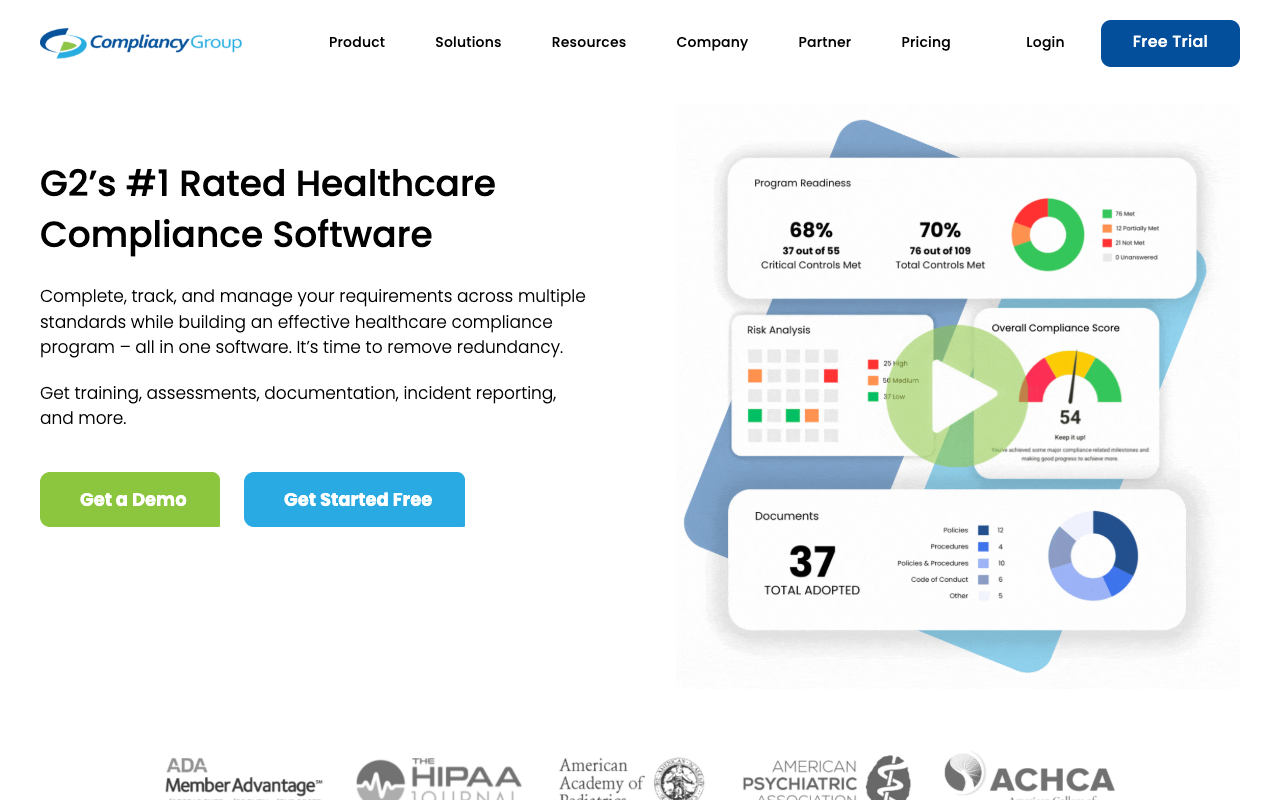
Governance, Risk, and Compliance (GRC) software platforms help healthcare organizations move compliance from reactive documentation to continuous oversight. Rather than assembling evidence at audit time, these platforms assign tasks, track policy acknowledgments, monitor corrective actions, and maintain audit trails as work happens.
Several platforms have added dedicated AI governance modules in 2026. Platforms like Compliancy Group, Accountable HQ, Abyde, and Medcurity offer HIPAA-specific modules covering risk assessments, policy management, and staff training tracking. More comprehensive enterprise GRC tools like Vanta and Drata support multiple frameworks simultaneously — HIPAA, SOC 2, ISO 27001, and HITRUST CSF — within a single dashboard, making them practical for organizations that need to demonstrate compliance to both regulators and enterprise clients.
The key capability to look for in a healthcare GRC platform with AI governance support is the ability to review AI vendors against the same standards applied to other vendors, document AI use cases as part of a formal risk register, and generate audit-ready evidence of ongoing oversight. Pricing for HIPAA-focused GRC platforms typically ranges from $299–$999/month depending on organization size and framework coverage.
Limitation: GRC platforms manage documentation and workflows — they don’t enforce technical controls. They should be deployed alongside, not instead of, IT infrastructure controls.
8. AI-Powered 24/7 Security Monitoring and Breach Detection
Best for: Healthcare practices running critical server infrastructure where downtime or a security breach would directly impact patient care
Continuous security monitoring is both a HIPAA Security Rule requirement and a practical operational necessity for healthcare organizations deploying AI tools. Any AI system processing PHI expands the attack surface — introducing new endpoints, API connections, and data flows that need to be continuously watched.
Modern healthcare security monitoring goes beyond traditional endpoint protection. The OCR has intensified HIPAA audits and penalties for inadequate risk assessments and encryption failures, with growing emphasis on ransomware protection, multifactor authentication, and real-time detection of anomalous data access patterns — exactly the type of behavior an AI model compromise would trigger.
Foris LLC’s 24/7 AI-Assisted Monitoring service uses proprietary management software to deliver deeper visibility, faster fixes, and tighter security than standard resale monitoring platforms. The system detects and responds to issues before they impact business operations, with proactive issue identification feeding directly into helpdesk escalation and patch management workflows. For small business backup solutions and disaster recovery needs, backup testing is included to ensure data recovery readiness — a specific HIPAA requirement that many organizations miss.
For managed IT services for small businesses in the healthcare sector, 24/7 AI-assisted monitoring removes the need for an internal security operations team while maintaining the continuous oversight HIPAA requires.
9. Microsoft Copilot Deployment with HIPAA Configuration Controls
Best for: Healthcare organizations already using Microsoft 365 that want to deploy AI productivity tools without creating new PHI exposure risks
Microsoft Copilot is the most widely requested AI productivity tool among healthcare administrative teams in 2026 — and one of the most frequently misconfigured. Deploying Microsoft Copilot in a HIPAA environment requires significantly more than purchasing a license. Microsoft’s enterprise Copilot offerings include BAA-eligible infrastructure through Microsoft Azure, but compliance depends entirely on proper configuration and usage. Oversharing permissions, misconfigured sensitivity labels, and insufficient access controls can expose clinical notes, billing records, or patient communications through Copilot’s natural language interface.
A proper Copilot rollout in a healthcare environment must address: sensitivity label configuration for PHI-containing files, SharePoint and Teams permission auditing before deployment, user training on which data types can and cannot be used in Copilot prompts, data loss prevention policy alignment, and post-deployment monitoring for unexpected data access patterns.
Foris LLC manages end-to-end Copilot Rollout for healthcare clients — covering planning, configuration, user training, and ongoing support to ensure successful adoption across the organization. As a Microsoft Copilot Partner, Foris integrates the deployment with existing HIPAA compliance controls rather than treating it as a standalone productivity initiative.
Limitation: Copilot requires Microsoft 365 E3 or E5 licensing to access enterprise features with appropriate security controls. Consumer or small business M365 plans have limited compliance tooling.
10. AI Receptionists Built for HIPAA-Governed Patient Interaction
Best for: Dental offices and healthcare practices looking to automate front-desk functions without creating new patient data liability
AI receptionists represent one of the highest-impact AI deployments available to small healthcare practices — and one of the most compliance-sensitive. An AI system handling inbound calls, scheduling requests, and patient communications is, by definition, collecting and processing PHI. Every interaction where a patient discloses appointment reasons, insurance information, or health conditions falls under HIPAA’s Privacy and Security Rules.
Dental office HIPAA compliance requirements apply fully to AI receptionist systems. The AI must be deployed on compliant infrastructure, the vendor (or internal IT team deploying the system) must operate under appropriate BAA coverage, all call recordings must be encrypted and access-controlled, and audit logging must capture every interaction involving PHI.
Foris LLC’s AI receptionists for dental offices service builds automated receptionist systems specifically designed for the workflows of dental and healthcare practices — handling inbound communications, appointment scheduling, and patient interactions with HIPAA-aligned configuration. Security and compliance review is built into implementation, not added as an afterthought. The service integrates with existing practice management systems and is coordinated through Foris’s broader managed IT engagement, so the AI receptionist operates inside an already-compliant IT environment.
Limitation: AI receptionists work best for practices with defined, repeatable patient communication workflows. Highly complex or specialized clinical intake processes may require customization.
How to Evaluate AI Compliance Solutions for Your Healthcare Organization
Not every healthcare organization needs all 10 solutions from day one. The right evaluation sequence starts with risk exposure, not feature lists.
Step 1 — Identify your highest-risk AI use cases. Where does PHI currently flow through or near AI tools? This includes diagnostic support systems, documentation tools, scheduling software, and any SaaS platform with an AI feature enabled.
Step 2 — Audit your current compliance posture. Do you have a current HIPAA risk assessment? Are all AI vendors under BAA? Is staff training documented? Foris LLC offers a free AI Readiness Review that surfaces these gaps before they become enforcement findings.
Step 3 — Prioritize by exposure severity. PHI flowing into public cloud AI tools is the highest-priority risk. Undocumented vendor relationships are next. Staff governance gaps are third.
Step 4 — Match solutions to gaps. Organizations with no HIPAA IT baseline should start with managed IT services that embed compliance into daily operations. Organizations with a solid IT foundation but AI-specific gaps should layer in GRC platforms, AUPs, and monitoring capabilities.
Step 5 — Build toward continuous oversight. The goal isn’t a one-time compliance project — it’s a compliance framework that’s resilient and ready for whatever regulatory changes come next. Contact Foris to begin with a free assessment.
Frequently Asked Questions: AI Policies in Healthcare
What does HIPAA require when using AI tools with patient data?
Any AI system that stores, processes, or transmits protected health information (PHI) must operate under a signed Business Associate Agreement with the vendor, implement encryption and access controls, maintain audit logs, and be covered by the covered entity’s existing HIPAA administrative, physical, and technical safeguards. HIPAA compliance is a shared responsibility — the AI vendor’s BAA supplements but does not replace the covered entity’s own obligations.
Is a Business Associate Agreement (BAA) required for every AI vendor?
Yes, if the vendor processes PHI on your behalf. This includes cloud-based AI documentation tools, AI scheduling platforms, diagnostic support systems, and any AI feature within an existing SaaS product that accesses patient data. A vendor claiming HIPAA compliance without offering a BAA is not meeting the legal standard. Always read the BAA scope clause — it must cover the specific surface area being used, not just the vendor’s platform in general.
Can a small healthcare practice afford HIPAA-compliant AI?
Yes. The cost of HIPAA-compliant AI depends heavily on the deployment model. Cloud AI tools with BAAs are often included in existing Microsoft 365 or Google Workspace enterprise licenses. Private LLM deployments require infrastructure investment but eliminate ongoing per-seat licensing. For practices with managed IT services already in place, AI compliance is often an incremental add-on rather than a standalone expense. The real cost of non-compliance — OCR fines starting at $100–$50,000 per violation — far exceeds the cost of proper controls.
What is the safest way to deploy AI in a HIPAA environment?
The architecturally safest deployment is an on-premises or private LLM where PHI never leaves the organization’s own infrastructure. This eliminates cloud PHI exposure and BAA dependency entirely. For organizations using cloud AI tools, the safest approach combines BAA coverage, encryption at rest and in transit, human oversight for high-stakes decisions, and ongoing monitoring for anomalous data access patterns.
How does the NIST AI Risk Management Framework apply to healthcare?
The NIST AI RMF’s four functions — Govern, Map, Measure, Manage — provide a structured governance methodology that HHS has recommended as complementary to HIPAA Security Rule requirements. Healthcare organizations use it to classify AI risk, document oversight mechanisms, measure system performance, and manage incidents. It’s flexible enough to adapt to any organization size.
Do dental offices need a special AI compliance policy?
Dental practices are covered entities under HIPAA and carry the same compliance obligations as medical offices. Any AI tool handling patient scheduling, clinical notes, or billing data requires BAA coverage, access controls, and audit logging. AI receptionists for dental offices must be specifically configured to protect patient communications involving PHI, including appointment reasons and insurance details.
The Right AI Compliance Partner Makes All the Difference
The 10 solutions covered in this guide address every layer of the AI compliance stack — from infrastructure architecture to governance policy to staff training to continuous monitoring. The challenge for most small and mid-sized healthcare organizations isn’t understanding what’s required. It’s executing across all of those layers simultaneously without an internal IT team equipped to handle it.
Foris LLC was built specifically to give small and mid-sized healthcare businesses access to the technology expertise and security practices typically reserved for much larger organizations. With CCIE-certified networking, 30 years of IT experience, and a service portfolio that spans HIPAA compliance IT, private LLM deployment, AI receptionists, Microsoft Copilot rollout, and all-inclusive managed IT — Foris provides one accountable technology partner managing the full compliance environment.
The free AI Readiness Review identifies quick wins and critical gaps before they become OCR findings or data breach headlines. Healthcare practices in Austin, San Antonio, and across Central Texas can get started with a no-commitment discovery call to assess current systems, surface compliance risks, and build a clear action plan.
AI is now supercharged with compliance capability — and so is Foris. Schedule your free assessment →